Laser cutting materials and thickness guide
What our fiber laser cuts, how thick, what the edge looks like, and which metal suits which job. Use it to choose before you send a drawing.
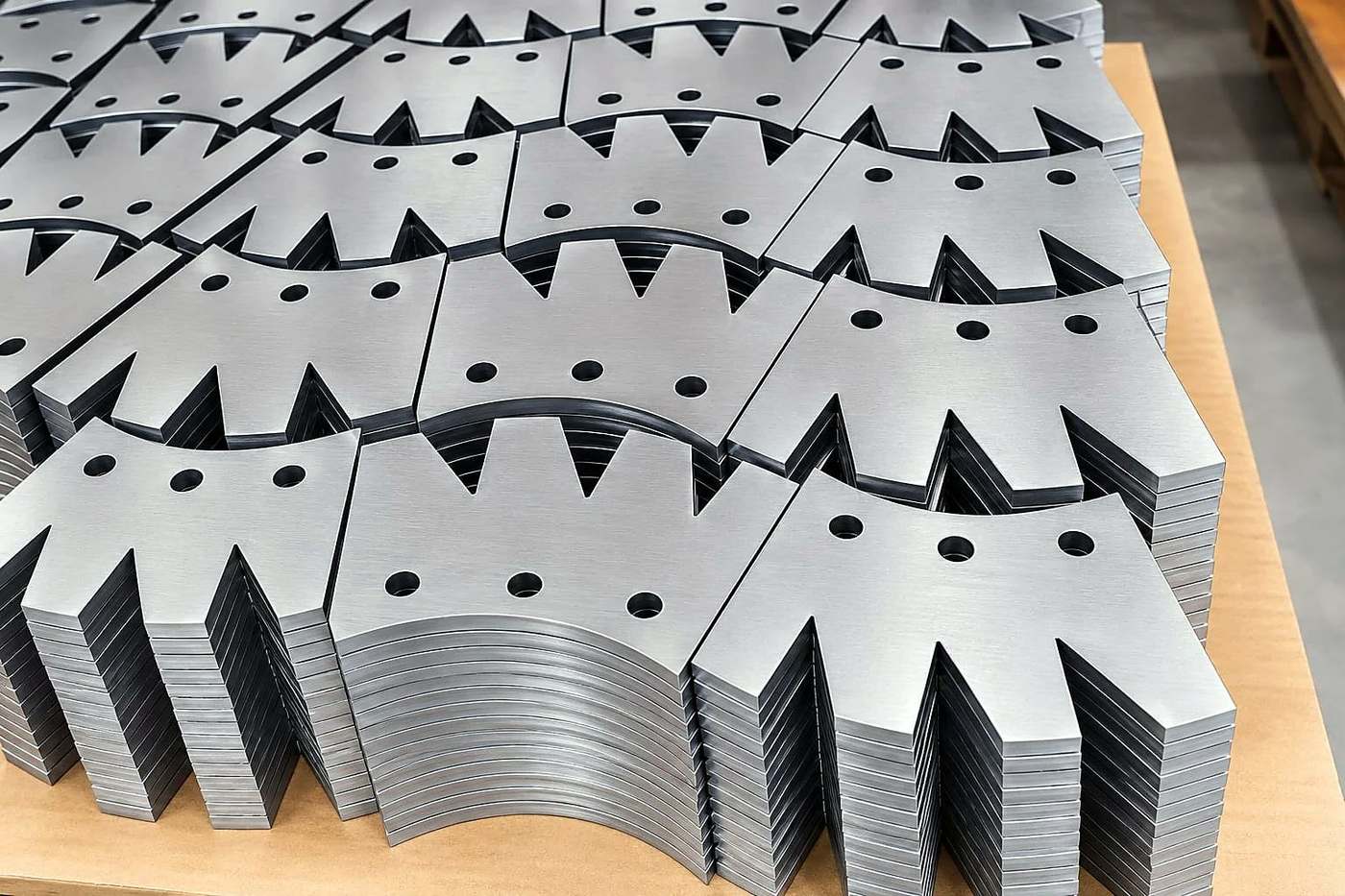
Cutting ranges
| Material | Thickness we cut | Assist gas | Edge |
|---|---|---|---|
| Mild steel (MS, CRCA, HR) | 0.8 – 16 mm | Nitrogen to 3 mm, oxygen above | Square, dross-free, paint-ready |
| Stainless steel 202 / 304 / 316 | 0.5 – 8 mm | Nitrogen | Bright silver, no oxide |
| Aluminium | 0.5 – 6 mm | Nitrogen | Clean, light burr on thick sheet |
| Galvanised (GI / GP) | 0.5 – 3 mm | Nitrogen | Zinc face intact |
| Brass | 0.5 – 4 mm | Nitrogen | Clean, fine detail to 1 mm |
| Copper | 0.5 – 3 mm | Nitrogen | Clean |
Ranges are for clean production edges. Thicker sections can sometimes be cut with a slower program depending on the profile, and anything beyond our laser goes to a partner plasma or waterjet shop.
Mild steel (MS, CRCA, HR)
The workhorse. CRCA sheet in 0.8 to 3 mm for panels, enclosures and brackets; HR plate in 4 to 16 mm for flanges, base plates and structural parts. Thin MS is cut with nitrogen for a bright, paint-ready edge; thicker plate with oxygen, which is faster and leaves a thin oxide that wipes off. Must be painted or powder coated to stop rust.
Stainless steel 202, 304, 316
Cut with nitrogen so the edge stays silver with no oxide, ready for brushing, polishing or welding. 304 is the standard for jali, kitchen and lift parts; 316 for chemical and coastal use; 202 is a cheaper option for indoor decor. Hairline sheet is cut through its protective film.
Aluminium
Light, rust-free and easy to powder coat, so it is the choice for facades, signage and enclosures. Cuts cleanly to 6 mm with a light burr on the thicker sheet that we deburr on request. Anodised aluminium also marks black under the laser, which is why it is used for name plates.
Galvanised, brass and copper
GI and GP sheet to 3 mm for panels and ducting, with the zinc face intact. Brass to 4 mm for decor inlays, name plates and electrical contacts. Copper to 3 mm for busbars and earthing strips. Copper and brass reflect the laser, so they are cut with nitrogen at controlled speed.
Choosing quickly
- Indoor decor on a budget: MS 2 mm, powder coated.
- Wet areas, kitchens, balconies: SS 304, 1.5 to 2 mm.
- Large exterior panels and facades: aluminium 3 mm.
- Gates and railings: MS 3 to 4 mm, powder coated.
- Flanges and structural plates: MS 8 to 16 mm.
- Panels and enclosures: CRCA 1.5 to 2 mm or GI 1.6 mm.
Not sure? Tell us what the part does and we will suggest the metal and thickness with the quote. See sheet metal laser cutting.
WhatsApp a DXF, PDF, photo or sketch. We reply with price and lead time the same working day.
Frequently asked
What is the thickest mild steel a fiber laser can cut?
Our machine cuts MS up to 16 mm with a clean edge. Thicker plate is possible on larger lasers or plasma, which we arrange through partners.
Does laser cutting discolour stainless steel?
Not with nitrogen assist. The edge stays bright silver. Oxygen cutting would leave a dark oxide, which we avoid on stainless.
Can you cut brass and copper?
Yes, brass to 4 mm and copper to 3 mm. Both are cut with nitrogen at controlled speed because they reflect the beam.
Is there a minimum hole size?
As a rule, hole diameter should be at least the sheet thickness, and not less than about 1 mm. Smaller holes are possible in thin sheet; we advise on the drawing.